
Supply & demand
Identify product specifications, cargo sizes, delivery windows and intended buyers. Distinguish recurring demand from a one-off cargo.
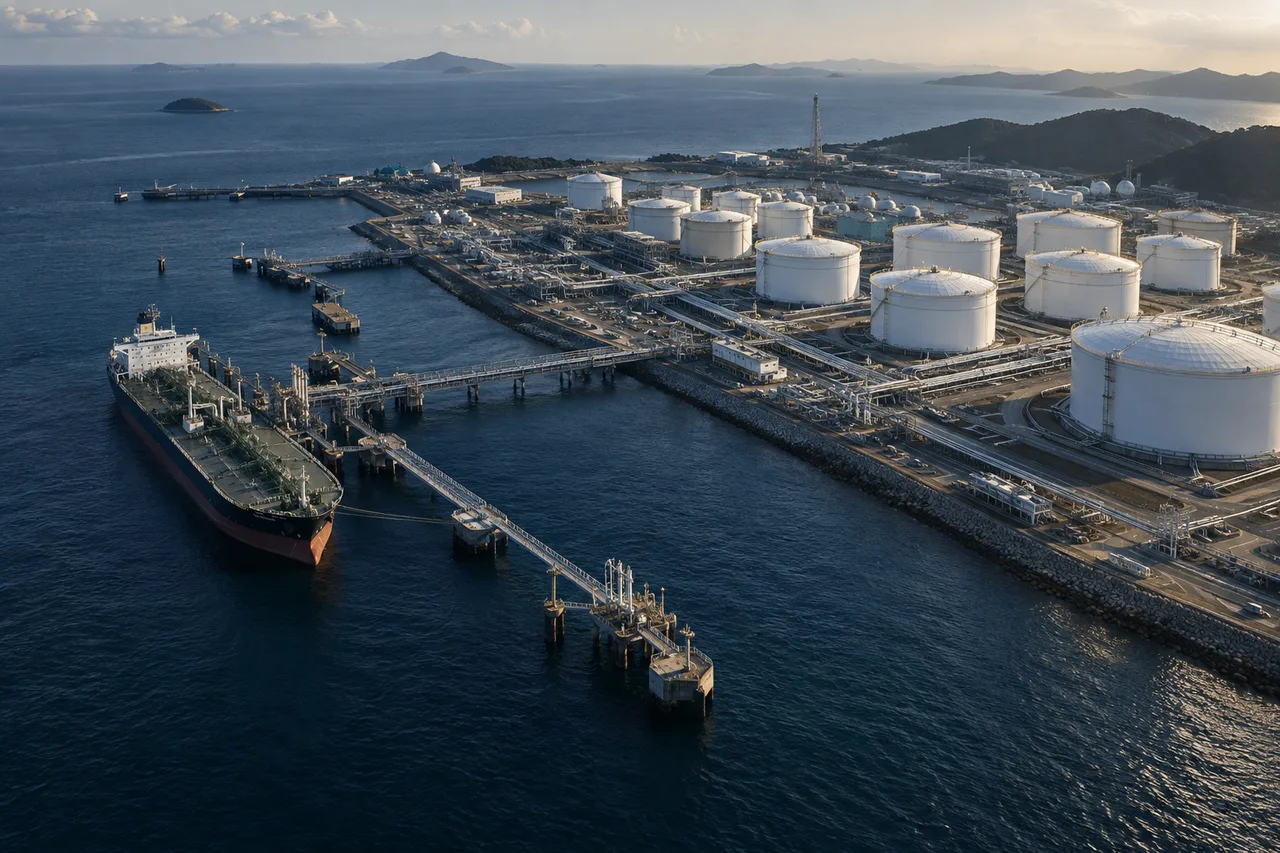
04 · Korea oil storage hub
When conflict leaves sellers unable to deliver and buyers unable to lift, cargo held in Korea keeps supply moving. We link Iraqi crude and petroleum products with Korean storage, Asian demand and storage-backed finance.
In development · Enquiries are not capacity reservations
AI concept image · not an actual project site
Energy security · Finance
Storing crude and products in Korea gives the producing country a sales outlet and Asian buyers a nearby source. The stored cargo can also secure financing: the lender would be a Korean securities firm and the borrower an SPC that the cargo owner sets up in Korea. PentaBay arranges and advises on the financing and acts as a seller; the structure is under discussion.
Read the guide: storing oil in Korea and financing it →Crude or products held in a Korean tank, with title and quantity confirmed by the terminal and an independent inspector, serve as collateral.
Expected proceeds from sales to Asian buyers are turned into funding today.
If the crude-owning country wishes, the funds can be tied to a project in that country developed by Korean companies, with payment made in Korea.
Products: crude oil and petroleum products such as naphtha and fuel oil; crude from 2 million barrels, product volumes agreed case by case. Storage: commercial terminals and tanks owned by small and mid-sized companies, with new purpose-built storage as the longer-term aim. Sales: normally re-export under bond; a government priority purchase could be discussed in special cases, subject to a government decision and contract. Financing is under discussion and depends on the lender's review and approval; this is not an offer of finance.
Development concept
Supply verification + logistics + demand assessment
Review scope
Identify product specifications, cargo sizes, delivery windows and intended buyers. Distinguish recurring demand from a one-off cargo.
Define capacity, storage duration, monthly throughput, handling requirements and inbound / outbound routes.
Map participant roles, operating costs and funding needs, and prepare storage-backed or receivables-based financing for review by Korean financial institutions.
We develop the supply, shipping, storage and sales concept with potential counterparties. Initial work covers product flows, participant responsibilities, cost assumptions and the next development decisions.
State the volume unit: m³, barrels or net metric tonnes. Mass-to-volume conversions require product density and a temperature basis. Explain any special handling requirements.
This is a development initiative, not an offer of operating tank capacity. Facility participation, available capacity, supply, funding and operating dates require project assessment and separate agreements.
Prepare the discussion
Estimates are welcome. Mark information that is not yet known and keep confidential documents for a separately agreed exchange.
Download the enquiry brief (.txt) ↓Send an enquiry
Use business contact details and non-confidential requirements. A successful submission displays a reference number. We use your business email for follow-up.
Prefer email? info@pentabay.org ↗
Before you enquire
Both help. Capacity is the quantity held at one time; throughput is the quantity moving through the operation over a month. State the unit for each and the storage duration.
Yes. Describe your proposed role, capabilities and the information needed to assess cooperation. Storage users can describe their product and demand.
We are discussing two forms with a Korean securities firm. The borrower would be an SPC that the cargo owner sets up in Korea, borrowing against crude or products stored in Korea or securitising future sales receivables. For crude, the structure is designed for parcels of at least 2 million barrels. Any financing depends on the lender's own review and approval; nothing on this page is an offer of finance.
No. The hub is in development. Facility participation, capacity, timing and commercial commitments require separate assessment and agreements.
Related reading